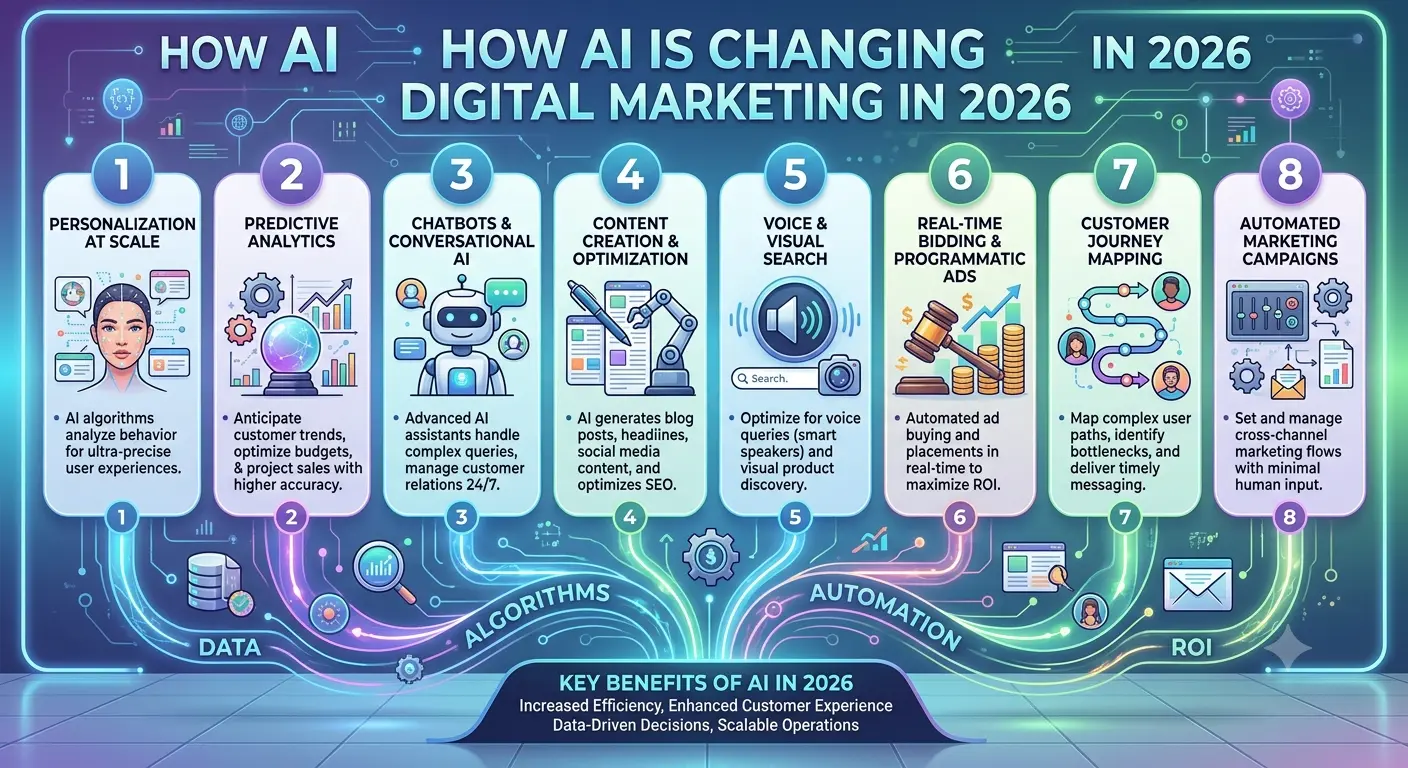
How AI Is Changing Digital Marketing in 2026
Artificial intelligence is no longer just a futuristic technology. In 2026, AI has become an important part of how businesses plan, create, promote, and measure their digital marketing campaigns. From generating content ideas and analyzing customer behavior to optimizing advertisements and personalizing user experiences, AI is changing the way marketers work.
The combination of AI and digital marketing is helping businesses automate repetitive tasks, understand their audiences better, and make faster data-driven decisions. At the same time, marketers still need creativity, strategy, human judgment, and a strong understanding of their customers to use AI effectively.
In this guide, we will explore the role of AI in digital marketing, the biggest AI marketing trends in 2026, popular AI tools, the impact of ChatGPT, and how businesses can use AI to improve their digital marketing strategy.
What Is AI in Digital Marketing?
AI in digital marketing refers to the use of artificial intelligence technologies to perform, automate, analyze, or improve different marketing activities.
AI can process large amounts of information much faster than humans. This allows marketers to analyze customer behavior, identify patterns, generate content ideas, optimize campaigns, and personalize marketing experiences.
The role of AI in digital marketing is not limited to one particular task. It can support SEO, content marketing, social media marketing, email marketing, paid advertising, customer service, analytics, and lead generation.
For example, an AI system can analyze previous advertising data and identify which audiences, messages, or campaigns are performing better. A marketer can then use those insights to make better decisions.
How AI Is Changing Digital Marketing in 2026
The biggest change is that AI is moving from being a simple productivity tool to becoming part of the overall marketing workflow.
1. AI Is Making Content Creation Faster
Content creation is one of the most visible applications of AI in marketing. Marketers can use AI to generate content ideas, create outlines, develop social media captions, write email drafts, and assist with blog content.
AI can help businesses overcome writer’s block and reduce the time required for repetitive content tasks. Instead of starting from a blank page, marketers can use AI to create an initial concept and then improve it using their own expertise and brand voice.
However, effective AI-driven digital marketing does not mean publishing everything generated by AI. Human editing, fact-checking, originality, and strategic thinking remain essential.
The best approach is to use AI as a creative assistant rather than treating it as a complete replacement for the content team.
2. AI Is Improving Customer Personalization
Customers expect brands to provide relevant experiences rather than generic messages.
AI can analyze customer interactions, browsing behavior, purchase history, and other available data to help businesses understand what different audiences may be interested in.
This allows marketers to create more personalized campaigns. For example, an e-commerce business can use customer behavior to recommend relevant products, while an email campaign can deliver different messages to different audience segments.
Personalization can help businesses make their communication more relevant and improve the overall customer experience.
3. AI Is Changing SEO and Search Marketing
AI is also changing how marketers approach SEO.
AI-powered tools can help with keyword research, search-intent analysis, content planning, competitor analysis, content optimization, and identifying content gaps.
At the same time, the search experience itself is changing as users increasingly interact with AI-generated answers and conversational search systems.
This means marketers need to think beyond simply inserting keywords into an article. Content should answer real questions, provide useful information, demonstrate expertise, and be structured clearly so that both people and search systems can understand it.
For businesses, digital marketing and AI are therefore becoming increasingly connected with modern SEO and AI-search optimization.
4. AI Is Transforming Paid Advertising
Paid advertising is another area where AI is having a significant impact.
Advertising platforms already use machine learning and automation to help marketers optimize targeting, bidding, placements, and campaign performance.
Marketers can also use AI to create different ad-copy variations, analyze campaign data, identify underperforming areas, and generate ideas for testing.
For example, instead of creating one advertisement and running it unchanged, a marketer can use AI to develop multiple variations with different headlines, benefits, and calls to action. These variations can then be tested to identify which messaging performs better.
AI can therefore make advertising optimization more data-driven and efficient.
What Are AI Tools for Digital Marketing?
AI tools for digital marketing are software platforms that use artificial intelligence to assist marketers with tasks such as content creation, research, analytics, advertising, SEO, customer communication, and automation.
Different tools serve different purposes. Some focus primarily on content and writing, while others are designed for SEO, advertising, customer service, analytics, or social media.
When choosing an AI tool for digital marketing, businesses should focus on the specific problem they want to solve rather than choosing a tool simply because it has AI features.
Best AI Tools for Digital Marketing: What Should You Look For?
There is no single best AI tool for digital marketing for every business.
The right tool depends on your marketing goals.
For example:
- Content teams may need AI writing and research tools.
- SEO professionals may need AI-powered keyword and content analysis tools.
- Social media managers may benefit from AI content and scheduling features.
- Advertising teams may need AI-powered campaign optimization.
- Sales teams may benefit from AI lead analysis and automation.
- Customer support teams may use AI chatbots and conversational tools.
Instead of asking which is the best AI tool overall, ask which tool solves your specific marketing problem most effectively.
How ChatGPT Is Changing Digital Marketing
ChatGPT for digital marketing has become useful for marketers because it can assist with a wide range of tasks.
Marketers can use ChatGPT to brainstorm campaign ideas, create content outlines, generate social media concepts, develop email drafts, analyze customer personas, create FAQs, and improve existing copy.
For example, a marketer could provide information about a product and ask ChatGPT to generate several campaign concepts for different customer segments.
However, the output should always be reviewed. AI may produce generic ideas or inaccurate information, and it does not automatically understand a company’s complete brand identity or business goals.
The strongest workflow is:
Human Strategy → AI Assistance → Human Review → Testing → Optimization
This approach combines the speed of AI with human creativity and decision-making.
How Businesses Can Use AI-Driven Digital Marketing
Businesses do not need to transform their entire marketing department overnight. AI can be introduced gradually into everyday workflows.
Step 1: Identify Repetitive Tasks
Start by finding tasks that take significant time but do not require constant human decision-making.
Examples include creating initial content outlines, summarizing data, generating ideas, or organizing research.
Step 2: Select the Right AI Tools
Choose tools according to your specific marketing requirements.
A small business may need only a few tools for content, SEO, and customer communication instead of investing in a large collection of platforms.
Step 3: Keep Humans in Control
AI should support marketers rather than make every strategic decision.
Human professionals should review important content, advertising claims, customer communication, and business decisions.
Step 4: Measure the Results
AI implementation should be measured using meaningful marketing metrics.
Businesses can monitor website traffic, leads, conversion rates, advertising performance, engagement, and customer acquisition costs to determine whether AI is actually improving their marketing process.
Major AI Digital Marketing Trends in 2026
Several trends are shaping AI digital marketing in 2026.
AI-Powered Personalization
Brands are increasingly using AI to understand customer behavior and deliver more relevant experiences.
AI-Assisted Content Creation
AI is becoming part of content workflows, helping marketers research, plan, draft, and optimize content.
Conversational Search
People are increasingly using conversational interfaces to discover information, products, and services. This is encouraging marketers to create content that directly answers questions.
Automated Marketing Workflows
AI can connect different parts of the marketing process, helping businesses automate repetitive tasks and move leads through marketing workflows more efficiently.
Predictive Analytics
AI can analyze historical data and identify patterns that may help marketers understand potential customer behavior and campaign performance.
Common Mistakes Businesses Should Avoid When Using AI
AI can improve marketing, but poor implementation can create new problems.
One common mistake is publishing AI-generated content without reviewing it. Content may sound generic, contain inaccurate information, or fail to reflect the company’s expertise.
Another mistake is using too many AI tools without a clear strategy. More tools do not automatically mean better marketing.
Businesses should also avoid completely removing human involvement. Marketing requires empathy, creativity, positioning, storytelling, and an understanding of customer psychology.
Finally, businesses should protect customer information and carefully consider privacy and data-handling requirements when implementing AI systems.
how ai is changing Digital Marketing in 2026?
AI is likely to make digital marketing more automated, personalized, and data-driven.
However, the future of marketing will not simply be about businesses using more AI. It will be about businesses using AI intelligently.
Marketers who understand their audience, develop strong strategies, and use AI to improve execution will have an advantage over businesses that either ignore AI completely or rely on it without human oversight.
The future of AI and digital marketing is therefore likely to be a combination of automation and human creativity.
Frequently Asked Questions About AI and Digital Marketing
How is AI changing digital marketing in 2026?
AI is changing digital marketing by helping businesses automate repetitive tasks, personalize customer experiences, analyze data, create content, optimize advertising campaigns, and improve SEO workflows. It allows marketers to work faster while making more data-driven decisions.
What is the role of AI in digital marketing?
The role of AI in digital marketing is to assist with research, content creation, customer analysis, personalization, advertising, SEO, analytics, and automation. AI can handle many repetitive and data-heavy tasks while marketers remain responsible for strategy and decision-making.
What are the best AI tools for digital marketing?
The best AI tools for digital marketing depend on the task. Content creators may need writing and research tools, SEO teams may need AI-powered optimization platforms, advertising teams may need campaign-analysis tools, and customer-service teams may benefit from AI chatbots.
How can ChatGPT be used in digital marketing?
ChatGPT can help marketers brainstorm ideas, create content outlines, draft emails and social posts, develop FAQs, analyze audience personas, generate campaign concepts, and improve existing marketing copy. Human review is important before using its output publicly.
Will AI replace digital marketers?
AI is more likely to change the role of digital marketers than completely replace them. AI can automate repetitive tasks, but strategy, creativity, storytelling, customer understanding, and business decision-making still require human input.
How can small businesses use AI for digital marketing?
Small businesses can start by using AI for content ideas, social media planning, SEO research, customer communication, email marketing, and data analysis. The best approach is to start with one or two repetitive tasks and expand AI usage after measuring the results.
Is AI-generated content good for digital marketing?
AI-generated content can be useful when it is properly researched, edited, fact-checked, and improved with original insights. Businesses should avoid publishing large amounts of generic AI content simply to increase the quantity of content on their websites.
Final Thoughts
AI is changing digital marketing by making many tasks faster, more automated, and more data-driven. From content creation and SEO to advertising, personalization, and analytics, businesses now have more opportunities to use artificial intelligence throughout their marketing workflows.
But successful marketing is not about replacing humans with AI. It is about combining AI technology with human creativity, expertise, strategy, and customer understanding.
For businesses entering the AI era, the best approach is simple: identify repetitive tasks, choose the right AI tools, keep humans involved, measure performance, and continuously improve the strategy.how ai is changing Digital Marketing in 2026
Ready to Build a Smarter Digital Marketing Strategy?
At BrandHook Media, we help businesses strengthen their online presence through SEO, content strategy, paid advertising, and modern digital marketing solutions.
Build a smarter digital marketing strategy with BrandHook Media Instagram .